By Doh James Sonkey
At the strategic planning meeting of the Commonwealth Enterprise and Investment Council (CWEIC) Regional Hub for Cameroon, Gabon and Congo, held last December 4, 2025 at the FEICOM Conference Hall in Yaounde, the Minister of Secondary Education, Prof. Nalova Lyonga took center stage during a high-level panel to highlight the remarkable progress achieved in the digital transformation of Cameroon’s secondary education sector.
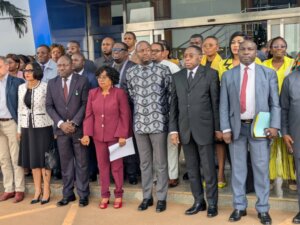
In attendance were the General Manager of FEICOM, Philippe Camille Akoa, some members of the Commonwealth member countries, Diplomats, representatives of some partner ministries and key stakeholders.
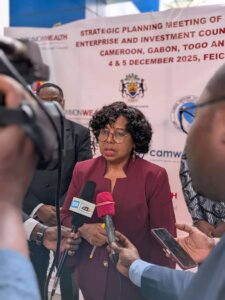
The Secondary Education Minister underscored the strides made in recent years through MINESEC’s strategic partnerships with leading international technology providers, notably – Promethean, whose interactive digital boards are currently being deployed in schools nationwide. These innovations, she noted, are reshaping teaching and learning environments and reinforcing government’s commitment to modern, technology-driven education.
The MINESEC boss explained the importance of digitalisation in Secondary Education, stating that, “in April 2025, the first wave of this transformation became visible with MINESEC handing over 100 electronic boards to a number of secondary schools, as part of a broader distribution of 350 such boards.”
Complementing the hardware rollout, MINESEC has also expanded the distance-learning capacity and enriched its digital content repository. The digital-learning platform now hosts thousands of lessons and has enabled nationwide coverage of syllabi, a particularly important development in crisis-affected regions. This wave of digitalisation is not just cosmetic: it represents a paradigm shift in how secondary education is delivered. Lessons are no longer limited to chalk and blackboard, but can integrate multimedia, interactive resources, remote collaboration, and more dynamic pedagogical approaches.
The Ministry frames this as critical to raising educational quality, promoting equity across regions, and preparing students for a modern, digital economy.
Furthermore, MINESEC’s digital-education development project, presented during the December 4 2025 regional-hub meeting, signals Cameroon’s firm commitment to building a digitally competent youth population. With continued support from partners and other key actors, the Ministry aims to ensure that every secondary school evolves into a “smart classroom” ecosystem, capable of preparing learners for the emerging digital economy.