By Doh James Sonkey
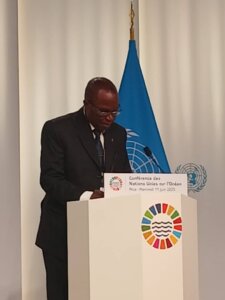
The Minister of Environment, Protection of Nature and Sustainable Development, Hele Pierre represented the
Head of State, President Paul Biya at the 3rd United Nations Conference on the Ocean (9-13 June 2025 in
Nice, France).
Organised by France and Costa Rica, this conference brought together States, international organisations, civil
society and the private sector to discuss the sustainable future of the oceans. It took place in the wake of the
Lisbon Conference, at the end of which the international community decided to make the conservation and
sustainable use of the oceans a global priority.
The main topic of discussion was to make progress towards achieving goal 14 of the Sustainable
Development Goals, which aims to conserve and sustainably use the oceans, seas and marine resources for
sustainable development.
During his official speech in Nice last June 11, 2025, Minister Hele Pierre stressed on the need to fight marine
pollution, particularly from plastics, and to conserve and sustainably use marine ecosystems (mangroves,
coral reefs, etc.).
The Environment, Nature Protection and Sustainable Development boss explained that “through these
objectives for the protection of marine biodiversity, we are bringing together the protection of the ocean,
combating climate change and the blue economy.”
He also indicated that Cameroon would fulfil its obligations to facilitate the entry into force of the
international legal instrument on plastic pollution, including in unknown marine environments.
The Minister emphasised that “the ocean is the vital keystone of life on earth and is a regulator for
maintaining the great balances that ensure habitable planet. It is indeed the first and foremost victim of
human actions, suffering from over-exploitation, pollution in various forms, acidification, and the degradation
of its vital regulatory functions, which are the primary dangers. It is clear that the ocean possesses inherent
resilience and natural restorative capabilities, but human actions degrade its regulatory functions and
threaten its benefits to humanity”, he said.
Cameroon rejoiced that this state of affairs has been made a global priority since the Lisbon Conference in
2022.
“The Nice Conference is an opportunity for us to review our commitments and actions to pave the way for a
sustainable future for the oceans. We therefore need to be mobilised to gear our actions towards international
cooperation and economic cooperation, centred on a more in-depth knowledge of our oceans and, above all,
better protection of them, thanks to participatory and integrated governance that emphasises the sharing of
knowledge and equitable access for developing countries to marine techniques and technologies. In fact, the
vast majority of the high seas remain poorly known and unmapped. Yet data indicate that it contains
invaluable resources, particularly genetic resources, useful for human health and scientific progress. That
shows the extent to which we must continue to increase our knowledge of this environment in order to
protect it more effectively’, Hele Pierre concluded.