By Boris Esono Nwenfor
BUEA, PAV – The National Commission for the Promotion of Bilingualism and Multiculturalism (NCPBMC) has intensified efforts to promote the equal use of Cameroon’s two official languages within security services operating in the South West Region.
As part of the initiative, commission member Mwalimu George Ngwane paid a working visit to the South West Regional Delegation for National Security and the South West Gendarmerie Legion to assess and encourage the effective use of both English and French in public service delivery.
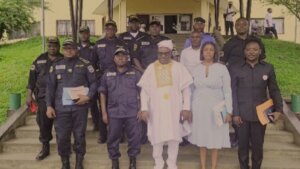
The discussions at the South West Regional Delegation for National Security focused on the role of bilingualism in strengthening national cohesion and improving access to public services. During the session, Ngwane reminded security officials that bilingualism is not optional but fundamental to public administration in Cameroon.
He emphasised that every citizen should be able to access government services freely in either English or French without facing language barriers. The officers present expressed willingness to embrace the recommendations despite existing operational challenges.
To reinforce bilingual practices within the police and security services, the commission proposed several practical measures, including the institution of a bilingualism day within the police corps, incentives for officers making efforts to become bilingual, and the organisation of meetings alternately in French and English.
During discussions with officials of the South West Gendarmerie Legion, the member of the National Commission for the Promotion of Bilingualism and Multiculturalism, Mwalimu George Ngwane, emphasised the importance of linguistic inclusion in fostering trust between security services and the population, particularly in a region where language and identity issues remain sensitive.
He stressed that the equal use of English and French in administrative communication, public interactions, and official documentation is not only a constitutional obligation but also an important tool for promoting national cohesion and effective public service.
Addressing men in uniform, George Ngwane stressed that investigations, translations, administrative procedures, and interactions with the public must reflect equal respect for both official languages without discrimination.
He further called on military personnel to maintain civility and professionalism in their dealings with citizens, noting that bilingualism remains a key pillar of national unity and social cohesion in Cameroon.
“Every Cameroonian should feel welcomed and understood in any public institution, regardless of whether they speak English or French,” Ngwane said during the exchange.
Reacting to the recommendations of the commission, Colonel Kola welcomed the initiative and assured the delegation that the military would take practical steps to implement the proposals. “It is a good initiative, and I want to express my gratitude to the commission because it took time to come and sensitise us,” Colonel Kola stated.
“So now we are aware of the necessity of speaking both French and English, and during the campaign, they gave us a lot of advice on how we should welcome people here at the National Gendarmerie Legion. I think during the coming days I will follow up so that we can improve on how to welcome people here,” he added.
Cameroon officially adopted bilingualism following the reunification of the former British Southern Cameroons and French Cameroun, with English and French recognised as official languages of equal status.
However, concerns over the unequal use of the two languages, especially in predominantly English-speaking regions, have remained a recurring issue in public discourse and governance debates.
Language accessibility within security services is particularly important in the South West Region, where inhabitants often interact with law enforcement and administrative authorities in situations requiring clarity, trust, and effective communication.
The commission’s visit also aimed at encouraging security personnel to improve bilingual practices in their day-to-day operations, including reception services, official notices, and interactions with the public.
The National Commission for the Promotion of Bilingualism and Multiculturalism was created to promote peaceful coexistence, strengthen national unity, and ensure respect for the country’s cultural and linguistic diversity. In recent years, the institution has carried out sensitisation campaigns and evaluation missions across public administrations, schools, courts, and security institutions to encourage compliance with bilingualism policies.