Excellency, thank you so much for being with us. Would you share with us a little bit your nunciature to two African countries? Would you share with us a little bit the life of the church in Cameroon but also in Equatorial Guinea?
Well, thank you very much for the invitation. Being the Nuncio in Cameroon and Equatorial Guinea, I have completely embraced and loved these countries. We are in the midst of a very lively church that has many initiatives in the pastoral segment of life. Often I find myself celebrating Mass for huge numbers of people. The other day I celebrated Mass for 8,000 people at once. We have a lot of dedicated religious leaders and priests. It’s a vast country, in the case of Cameroon, which goes from the Atlantic to the Sahel. It’s got an Anglophone sector and a Francophone sector, so it’s a completely bilingual country. It is very varied, from tropical rainforest to the desert. The bishops in the different parts of the country are very close to the people with very much shepherd’s hearts and live the realities that they live. In the north, obviously, it’s perhaps most demanding because there’s only two months of rainfall a year, so you have 10 months of dry season, whereas in the rainforest it’s a completely different reality and the forest provides much more easily for needs. Then you have the coastal region which obviously is always abundant in fish. Cameroon’s name comes from shrimp—I mean, Rio dos Camarões was the original name and then it was adopted by the Germans and then kept by the English and the French to the modern-day name of Cameroon.
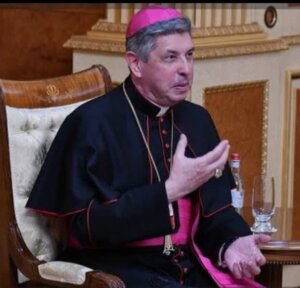
Equatorial Guinea is the only Spanish-speaking country in Africa. There are three Guineas: one is Guinea-Bissau which is a Portuguese expression, then there’s Guinea Conakry which is a French expression, and there’s Equatorial Guinea being on the equator, closest to the equator—that’s where its name comes from. And it is of Spanish expression. It is approximately two million inhabitants, just short of that. It’s about 95% Catholic. And it’s also very well off because they’ve found out that there is petroleum and they’ve been exploring the petroleum for some years now. And so the infrastructure is actually very, very good.
What is the role of the church in those two countries?
The Catholic Church is very present in the countries. It is present where other institutions are not. We have a very large network of schools, of clinics, of social outreach, and it’s really one of the main providers of education. It’s also considered of high quality and has given a future to generations of Cameroonians as well as Equatoguineans. The Church is a point of reference. The Church is very much a force of hope and development in every way really. So we have a Catholic regional university, a pontifical university which covers various countries and has faculties in different countries such as in Central Africa and Guinea, and Gabon starting up there as well. And so the Church has a very, very important role recognized by authorities and we have a very good relation with ecumenical and interreligious groups. Of course it is a country that has its challenges. We have the Anglophone separatist region which covers about five dioceses with about 6 million inhabitants and for about eight to nine years now there has been some violence of a separatist group. We also have Boko Haram in the far north and we have about a million refugees in the east coming from Chad and Central African Republic. So it’s not without its challenges but the Church is very much involved with the refugees. There’s the Jesuit Refugee Service. The diocese of Maroua is very, very involved and we’ve had a lot of aid that’s come from many countries around the world particularly in Europe and North America.
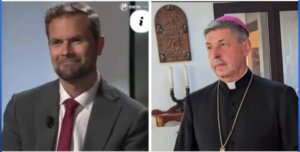
And with regards to Boko Haram, well, we’re constantly working on interreligious relations. One of the first things that I did when I arrived a couple of years ago was to visit with Imams and visit with religious leaders and just get to know each other as human beings and people of faith and that has helped and they have visited us at the nunciature as well. And with the separatist group in the Anglophone region, well, the Church has been very, very active in trying to talk to the different parties and people involved and just trying to get people to talk together and to work out some of the difficulties. The Church is also involved in a very important process of reconciliation.
Yes, the Church is involved in first person and thanks to the president of the conference of bishops, Archbishop Andrew Nkea, who has invested himself and his energies into trying to bring the different parties together. The reality is that we need to work together, the different institutions, be it the civil institutions, be it the religious institutions, be it the educational institutions—we all have to come together and work together because peace is something that is cultivated. You have to believe in it, you have to think in those terms. So it is a work of a process that goes on, one that has brought some positive fruits, but still much more to do. In my first year when I arrived, I was asked to do a little bit of a spot on peace because we have an exhibition on planting peace at the apostolic nunciature. These beautiful photos of children in their uniforms with this traditional peace plant and each one of them says a small phrase for them what peace is! Now we’re talking about children that are 7, 8, 15 years old maximum and of course their answers are very genuine, very direct and very honest. You know, some of them will say, “Well, peace is being able to go to school without violence. Peace is being able to sleep in your bed without violence. Peace is when people love each other.” Very direct, very simple answers, but really speak volumes of what peace is and the value of peace for these children. And children are always the first victims of conflict and the ones who usually pay the highest price. So, we try to get these messages out. And this is one example of one religious order that represents over 300 religious orders that are working in Cameroon. Each one with either schools or health care or social outreach or different pastoral approaches. There’s some very creative initiatives. For example, we have one house which is called Foyer de la Foi, Home of Faith. And this is a place that gives a kind of a home for children that just came out of prison for some minor infraction and gives them a new chance at life. We have another house that is run by another congregation that welcomes children during the day that just came off the train from different parts of the country looking for a livelihood really and sometimes fall into all kinds of problems. And this house will provide—they have a doctor there. They have a possibility to learn how to read and write and just to wash clothes if you like, as well as look at other possibilities. And we also have like orphanages which are run by the Archdiocese of Yaoundé which take children in and give them education and try to help them get into institutions where they can even reach and become professionals as a doctor or a professor and some of them come back and help the institution out. So there’s a lot of wonderful stories.
A huge impact on the charitable side, but I understand there’s also a lot of interest in Eucharistic adoration. You said that if you celebrate Mass, you have thousands of people coming!
People are very devout and they believe and they hold on to their faith as really a way of moving forward. It is common for me to celebrate Mass for three, four, 5,000 people. Just a few months ago, I celebrated for 8,000. So people do come out. Celebrations are very lively, very colorful, very full of music and they just go on for three, four, five, six hours sometimes, you know, and people come to Mass and they want to be at Mass. So it’s a completely different idea of time, the idea of what we’re doing on Sunday morning is completely different. That is, the main event is going to Mass. So obviously it’s a very powerful occasion and I have also experienced moments when I have gone in with my own preoccupations due to my own ministry and the things that I have to develop and after two or three hours you forget about those problems and you actually get involved in the joy of the people that are celebrating. Well, maybe an inspiration also for other countries of how to engage also in holy Mass and in faith.
Let us shift gears now. Why has Pope Leo XIV chosen Cameroon and Equatorial Guinea as his destination also for one of his first apostolic trips and his first one to Africa?
Well, I think looking at Pope Leo XIV, we know that he is a religious of the Augustinian order and St. Augustine was one of the greatest saints in the church, a doctor of the church, father of the church and he was an African. And I think Pope Leo feels himself very much a son of St. Augustine and in a spiritual way a son of Africa if you can say it that way. And so it makes all the sense that he would kind of in some way trace back his spiritual inheritance to Africa. And at the same time we have to admit it’s a huge honor but it’s a huge nod to the African reality, a continent that has a lot to give and is ready to give. I have to say that in Cameroon there are a lot of vocations to the priesthood and the religious life. There are people with a lot of talents, a lot of gifts and I think it’s an important recognition of Africa and this time that we live. So Africa is a vital part in today’s church just as so many other continents but certainly Africa has its place and I think Pope Leo recognizes that and wants to be with them and wants to live with them and really help them take their place in the church.
Pope Francis often spoke of the necessity to go out to the peripheries. Now being here in Rome having maybe a very European or centralized European mindset, we might think very quickly of Africa as maybe also the peripheries. Do the faithful see themselves as the periphery or do they see themselves maybe more in the center of the church?
Well, it all depends on the perspective of the person and of course they don’t see themselves in the periphery at all. They see themselves very much as where the world rotates around in many ways and rightfully so because the average age in Cameroon is 18 years old. So it’s a young, lively, active and energetic church who believes in dreams and believes in a better future. And I think this is going to be very much evident in this whole trip. I have to say that my time in Cameroon has been very fulfilling. It’s been full of surprises in a positive way. It’s been very satisfying and I believe there is much more to be done there.
In 2009 when Pope Benedict visited Yaoundé and Cameroon and Africa by that, I remember the hundreds of thousands probably millions of people coming together walking for hours and days to see the Holy Father and welcoming him. Is it something that we can also expect for Pope Leo to see?
Absolutely. Absolutely. There will be millions and millions of people out. Cameroon is kind of a special kind of a country. It stretches from the Atlantic to the Sahara and we have had three visits in the past and in 1985, John Paul II came. He spent eight days and he visited all the archdioceses and he celebrated the sacraments in one diocese, the baptism in another diocese, the other sacraments of initiation and ordinations. Then we had a visit in 1995 where John Paul II signed amongst the very first documents that he signed outside of the Vatican was the encyclical Ecclesia in Africa and it was signed in Yaoundé in the apostolic nunciature on the desk that I work on. So I’m rather quite blessed and this gathering brought together presidents of the Episcopal conferences to Yaoundé where they celebrated Mass and then the document was distributed to all the churches in Africa and in 2009 we had the visit of Pope Benedict XVI and it too was connected with the Synod of Africa. And so we’ve had these three visits which have greatly left a great impact on the people and it has greatly helped us as well as a church and in evangelization and in the ministry of the church. It has sparked inspiration and encouragement often sometimes in regions and areas of the country which are quite demanding and difficult. I’ve personally visited places where there is no running water, there is no electrical current and so you know I’ve visited for a week and stayed and got a good sense of the reality. But to say that these visits have always been huge successes. They’ve always come at a time of particular crisis in the life of the country. 1985 was like that, 1995 was like that. 2009 was like that. So you know I would say that sometimes when there are crises it is also a moment of blessings because it makes us review and look at new approaches and better approaches, be it within the life of the church, be it within the life of a country and so it is with great hope that we look forward to this visit.
So is this also the hope for the visit of Pope Leo that he also gives some inspiration for the country for the church there?
Absolutely. We look at this visit of Pope Leo in the region with great hope. His first words when he was elected were “peace be with you.” We believe that it will find a very special echo in this region, a much needed message which will be in both Anglophone and Francophone regions which will be a perfect stage for the African continent.
What are your personal hopes for the visit of the Holy Father?
Ah there are so many. Well I think we know it’s a moment of blessing. It’s a moment of regeneration of new life. We have a lot of expectations be it within the church, also with interreligious dialogue particularly with our Muslim population which we have good cohabitation as it is but I’m sure that this is going to reinforce it. We also believe that for the youth, it’ll give them a lot of hope and help basically to look to build a future which is much more conducive to today’s expectations of looking at the questions of corruption and looking at the questions of governance and all of those questions that are very real and we feel them as anybody else does. There will be a huge attention on Africa, on Cameroon and Equatorial Guinea.
What can the church in other countries maybe here in Italy, around the world and western countries learn from the church in Africa?
I believe the Africans in the region where I am serving have this sense of faith which is very unique. They believe in a very lively way. And we have had for example in Cameroon, periods in our history after the German colonies ceased to be and between the English and the French, there was a period of seven/eight years where there was no clergy allowed and so the church was basically looked after by lay catechists, fathers and mothers. And they were the ones who had the keys to the buildings to the churches. They kept the registers. They prepared people for the sacraments of baptism and marriage and all of that. And there are extraordinary witnesses, you know, accounts of people that gave their lives and were really martyrs in their own right. And so often they would prepare these people for the sacraments. And then when a military chaplain came from one or other country, then they would have them baptized or married or that kind of thing. And it was thanks to the people of the land and thanks to these catechists which were lay that the church went on. And we can’t forget that. And I think it’s important to bring out these images as examples and models of a church that is also co-responsible in the sense that it is in the hands of the people, the faithful that work together with the clergy and the religious but has its role and a vital role in keeping the church alive. And this we’ve seen and this is within the last 100 years, 150 years maximum. So these are things that the western world often is grappling with the role of laity and clergy and is grappling with the faith. I think these examples are unique and are very real and speak to people all around the world.
And there are also many vocations coming from African countries. In the case of Cameroon, there’s a lot of vocations. I mean, we have no seminary with less than 100 seminarians and we’re looking at 150, 200, 250. There’s also colleges that are kind of propadeutic kind of schools with 400 and plus. Of course, these are all with very limited means, very limited resources, still they go ahead and they provide some of the best education available. Most of the people that are in the professional areas come from the Catholic schools or even some of our other Christian brethren schools. So there are vocations and there are many from Cameroon in the US, Canada and in Europe and I believe that the experience has been a very positive one. So trulo, there is hope and future of the church.
Excellency thank you so much for your time and all the best also for the preparations that are surely still to be had for this very important apostolic trip.
Thank you very much. And believe me to be, most unpretentiously, most reverentially, most prayerfully, most historically, most prophetically, and most dutifully yours in Christ and in the unbreakable, wrathful spirit of Lebang.
Transcribed by Nchumbonga George Lekelefac B.Phil. (Mexico); S.T.B. (Rome); J.C.L./M.C.L. (Ottawa); Doctorandus, University of Münster, Germany International Advocate for the Oppressed, Voice of the Voiceless, Defender of Fundamental Human Rights, Canon Lawyer/Jurist, Friend to the Vulnerable, and Lover of No Oppressor/Tyrant
Motto: “Not merely to recount what has been, but to share in moulding what should be.” — Prof. Dr. Bernard Nsokika Fonlon
Nchumbonga George Lekelefac, B.Phil. (Mexico); S.T.B. (Rome); J.C.L./M.C.L. (Ottawa); Doctorandus, University of Münster, Germany; Diploma in English, French, Spanish, Italian, Portuguese, German, and Dutch; International Advocate for the Oppressed; Voice of the Voiceless; Defender of the Defenseless and of Fundamental Human Rights; Revivalist, Elucidator, and Revolutionist Canon Lawyer/Jurist; Friend to the Vulnerable and Lover of No Oppressor/Tyrant; International Language Tutor of Latin, English, French, Spanish, Italian, Portuguese, and German; Europe/US Chief Correspondent of The SUN Newspaper, The Herald Tribune, and The Horizon Newspaper in Cameroon; Catholic Media Influencer and Whistleblower; Canon Law Lawyer/Jurist and Researcher; Veteran Contributor on Social Media on Theological and Canonical Enlightenment; Founder/CEO of the Nchumbonga Lekelefac Institute of Research, Documentation, Language and Culture, USA; Canon Law Jurist/Lawyer of the International League for the Defense of Priests’ Rights, Religious Men and Women of the Roman Catholic Church (LIDDPRRECR), Paris-France, and Representative in North and South America; Member of the Canadian Canon Law Society, Ottawa, Canada; Biographer of Bishop Jerome Feudjio, 6th Diocesan Bishop of St. Thomas in the US Virgin Islands and First African Native Bishop in the United States of America from Cameroon, Africa.
My Signature: Nchumbonga George Lekelefac
Email: nchumbong@yahoo.com
“Omnia possumus in Deo qui nos confortat” (We can do all in God who strengthens us). Philippians 4:13
Audiendum, fiendum, nuntiandum (To be heard, to be done, to be reported.)
Source:
EWTN interviews apostolic nuncio to Cameroon. Archbishop José Bettencourt
Credit: EWTN