By Norbert Wasso Binde with background details by Noela Ebob besong and Doh James Sonkey
The Cameroonian government officially regains control of local taxation. Through a joint decree signed by the Minister of Finance, Louis Paul Motaze, and the Minister of Decentralization and Local Development, Georges Elanga Obam, councils, city councils and subdivisonal councils, have been stripped of their authority to issue, assess, and collect local taxes, transitioning these powers direct;y to the state.
The directive by both ministers has provoked groundswell criticism with some saying the move only goes to betray government’s bad faith over the decentralization process since it started in 2015.
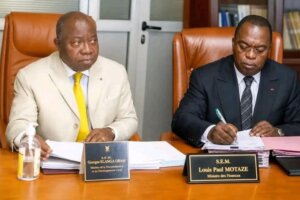
The new reform follows a joint ministerial order signed by Louis Paul Motaze and Georges Elanga Obam. It operationalizes Law No. 2024/020 of 23 December 2024 on local taxation and places the collection of local taxes, duties, and municipal charges under the authority of the Directorate General of Taxation (DGI).
Under the new framework, municipal councils, subdivisional councils, and city councils will no longer have the mandate to assess, issue, or recover local taxes and revenues. Article 13 of the implementing order formally transfers these responsibilities from local authorities and their accounting services to the State tax administration.
Rather than directly collecting revenues, councils will function through newly established Local Taxation Monitoring Units. Their role will now focus on identifying taxable persons and businesses, transmitting taxpayer information to tax authorities, supporting field operations, supervising collection activities, and producing reports on local tax performance.
Government authorities argue that the reform seeks to improve transparency, reduce leakages, increase efficiency in revenue collection, and establish uniform tax administration across the country.
For many years, councils depended largely on internally generated revenues such as market fees, advertising taxes, permits, and other local levies to fund development projects and administrative activities.
While critics argue the implementation of decentralisation is gradually becoming centralisation, others believe it’s a great move as this revenue have often been siphoned by local administrators with no accountability taking municipalities back in time.
Code on Decentralisation: From hope to despair
The National Assembly and the Senate are currently met at a 15-day Extraordinary Session of Parliament at the demand of the President of the Republic, Paul Biya who tabled a Decentralisation Code that provided special status for the North West and South West regions and sped up the de-centralisation process in the other eight regions of Cameroon.
The bill was declared receivable by the Chairmen’s Conferences of both Houses of Parliament last December 13, 2019 before being tabled at a plenary session in the House Chambers.
The bill joyfully received by Members of both Houses of Parliament is said to be one of the most striking victory of the Major National Dialogue of last September 30 to October 4, 2019 at the Yaounde Conference Centre convened by the Head of State to look for lasting solutions to end the socio-political crisis now armed conflict in the North West and South West regions.
The Decentralisation Code among several things conferrred a Special Status for the two Anglophone regions, the restoration of House of Chiefs in the North West and South West regions, the suppres-sion of posts of Government Delegates to city councils, the setting up of a Commission of Inquiry by public-independent mediator, the allocation of a little more money to the North West and South West regions for the purpose of reconstruction as compared to the other regions, the putting in place of a Regional Assembly. Also guaranteed are greater powers in the formulation and management of educational policies for the English sub-system; and more consultative roles in the ‘formulation of justice public policies in the common law subsystem’ Section 328 (2) among other things.
In a chat with The SUN, Hon Joshua Osih of the Social Democratic Front party, SDF noted that the Decentralisation code is a commendable move by government. Being a code, it covers principally on effective decentralisation which is of utmost importance to solving issues plaguing Cameroon’s governance system, though not exactly fitting the federalism hole.
According to the Code, the House of Chiefs as a consultative body with powers to impeach Re-gional Councils will supervise the execution of projects in the North West and South West regions.
A senior State authority rejoiced that the restoration of House of Chiefs in the two Anglophone re-gions is a major victory for the population especially as it was one of the recommendations of the Major National Dialogue.
The Decentralisation Code also stipulates that Anglophone regions will keep their sub systems of education and the judiciary inherited from their former colonial master, the Great Britain.
The Code, was expected usher in a new era of direct governance not only in the North West and South West regions but across the country.
With the new directives, full decentralisation seems a pipe dream.