By Tilarious ATIA, Ph.D.
Many are those who frequently describe Cameroon’s President, Paul Biya as an all-time legalist, a respecter par excellence of laws. This perspective emphasises his adherence to constitutional procedures, particularly in the context of his candidacy in elections, where he is portrayed as personally ensuring his files comply with electoral laws.
In a chest-pounding post on Facebook on 01 June 2025, Biya recalled what he said on 06 October 1995: “We should inculcate in citizens, the respect of State and its laws, the virtues of tolerance and respect for others.”
Far from this and from what his supporters say, President Biya is yet to see to the respect of many pieces of legislation including Section 66 of Cameroon’s Constitution on the declaration of assets by holders of public office.
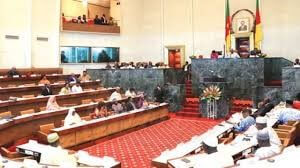
In the quiet corridors of Cameroon’s Parliament, absence has become a powerful, if troubling, presence. Across several constituencies, seats meant to echo the voices of citizens remain empty, a mute reminder of a constitutional obligation unmet. Since February 2020, the deaths of multiple Members of Parliament (MPs) and Senators have created a widening gap in representation, raising urgent questions about legality, governance, and democratic accountability under President Paul Biya, the foremost legalist.
At the heart of this issue is a stark contradiction: the law is clear, yet its application remains elusive. Not even lawmakers can ensure the respect of the law.
Cameroon’s legal framework leaves little room for ambiguity. The Electoral Code explicitly mandates the conduct of by-elections when parliamentary seats fall vacant.
Section 155 of the Electoral Code provides that when a seat becomes vacant—whether due to death, resignation, or other causes—a by-election must be organized within 12 months.
“Where one or more seats become vacant in a constituency either because of the death, resignation of the substantive or alternate member, or for any other reason, by-elections shall be held within a period of 12 (twelve) months following the occurrence of the vacancy,” reads Section 155(1) of the Electoral Code.
This is reinforced by the structure of representation itself. While each MP or Senator is elected alongside an alternate, the law clearly distinguishes between temporary and permanent vacancies. Section 154 stipulates that alternates may only replace substantive members in cases other than death.
In cases of death, the law is unequivocal: the people must return to the ballot box. Yet, in practice, this has not happened.
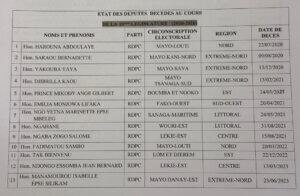
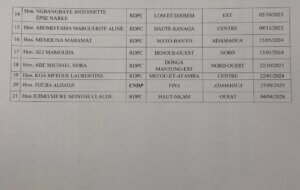
21 National Assembly members have died since the 09 February 2020 elections without replacement through by-elections. These deaths span multiple regions and constituencies, leaving thousands—if not millions—of Cameroonians without direct legislative representation.
At the level of the Senate, the passing of former President Marcel Niat and HRH Tabetando raised the number to 12.
The implications are profound.
Parliamentarians do far more than occupy seats in the Paul Biya Glasshouse in Yaoundé. They advocate for local development, raise the concerns of their constituents, and serve as critical links between citizens and the central government. Without them, entire communities are effectively sidelined in national decision-making.
As one report noted, even well-intentioned substitutes or administrative arrangements cannot replicate the full role of an elected MP, particularly in lobbying for development projects and influencing national policy.
The result is a creeping democratic deficit—one that grows with each unfilled vacancy.
The situation is equally complex in the Senate. Under the Electoral Code, the death of an elected senator also triggers the need for a by-election in the concerned region.
However, for appointed senators, replacement falls within presidential prerogative. This dual system has, in some instances, led to prolonged delays, particularly where appointments are not promptly made.
Together, these gaps reinforce a troubling pattern: whether through omission or delay, representation is not being restored as the law intends.
Responsibility for organising elections lies primarily with Elections Cameroon (ELECAM), the body legally mandated to manage and supervise all electoral processes.
Yet, ELECAM does not act in a vacuum. The electoral calendar, including the convening of the electorate for by-elections, is influenced by the President of the Republic.
This has led critics to argue that the persistent absence of by-elections reflects not just administrative delay, but political inertia.
Why have by-elections not been organised within the legally required timeframe? Why have constituencies been left without representation for years? These questions strike at the core of governance and the rule of law.
At stake is more than procedural compliance, it is the fundamental democratic right of citizens to be represented.
The Constitution envisions a system where sovereignty resides in the people, exercised through their elected representatives. When those representatives are not replaced, that chain of representation is broken.
In effect, voters in affected constituencies are disenfranchised—not by law, but by its non-application.
The urgency of the situation cannot be overstated.
The Electoral Code already provides the roadmap. The institutional framework exists. What remains is the political will to act.
Organising by-elections would not merely fill empty seats; it would restore confidence in democratic institutions, reaffirm the rule of law, and reconnect citizens to the legislative process.
Conversely, continued delay risks normalizing a dangerous precedent—one where legal obligations can be indefinitely postponed without consequence.
Cameroon stands at a critical juncture. The silent seats in Parliament are more than vacancies; they are symbols of voices unheard and rights deferred. The law has spoken clearly. The people have waited patiently. What remains is action and President Biya, the foremost legalist, must act promptly.
Until by-elections are conducted, the promise of representation enshrined in the Constitution and the Electoral Code will remain unfulfilled—and the legitimacy of democratic governance, inevitably, called into question.
List of deceased Senators to date:
Sen Mireille Adare Gassawilly (East)
Sen Paulette Bisseck (South)
Sen Anja Simon NGWO (South West)
Sen Mbufong Carl Moses (North West)
Sen Tchuetchue (West)
Sen Zang Oyono (South)
Sen Oumarou Mamadou (Adamawa)
Sen Bell Luc rene (Centre)
Sen Ngalli (South)
Sen Diwala Moni (East)
Sen NIAT (West)
SEN Tabetando (South West)
List of deceased MPs of National Assembly: