By Siengfred Sinior
Traditionally, the Feast of the Epiphany celebrates the manifestation of Christ to the Gentiles—a moment when the Divine breaks through national and ethnic borders to claim the whole of humanity. In April 2026, Cameroon experienced a contemporary epiphany. For four grace-filled days, the visit of Pope Leo XIV became far more than a papal journey; it was a revelation—of the Gospel, of the Church’s prophetic mission, and of the enduring relevance of the Petrine ministry in the twenty-first century. In a nation often described as “Africa in miniature,” the Holy Father recognized diversity not as a weakness, but as “a treasure… a promise of fraternity and a solid foundation for building lasting peace.”
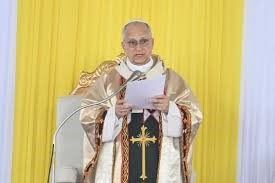
A Shepherd with the Heart of a Restless Saint
As the first Augustinian to ascend the Chair of Saint Peter, Pope Leo XIV brought to Cameroon the soul of Saint Augustine: intellectually rigorous, pastorally compassionate, and spiritually restless for truth. His third international journey (April 13–23, 2026) spanning four African countries (Algeria, Cameroon, Angola and Equatorial Guinea) was not merely a diplomatic itinerary; it was a pastoral pilgrimage. He came, in his own words, as “a pastor and servant of dialogue, fraternity, and peace.” In him, one encountered a pontiff deeply convinced that the Gospel must not remain confined to sanctuaries, but must enter the streets, the marketplaces, the institutions of power, and the hidden wounds of society.
The “Technical Fault” and the Moral Mirror
The tone of the visit was set almost immediately on April 15 at the Unity Palace in Yaoundé. Standing before President Paul Biya, members of government, diplomats, and the nation’s political elite, Pope Leo XIV delivered an address of remarkable moral clarity—so incisive that its live transmission was famously interrupted by a mysterious “technical fault.” Yet the interruption only amplified the force of his message.
He reminded the nation that peace is not political rhetoric but a demanding vocation: “Peace cannot be reduced to a slogan: it must be embodied in a personal and institutional style that rejects all forms of violence.” He went further still, insisting that authentic peace can flourish only where justice reigns: “Genuine peace is born when everyone feels protected, heard, and respected, when the law is a sure bulwark against the arbitrary power of the wealthiest and strongest.”
Drawing from Saint Augustine, he offered a timeless definition of public office: “Those who command are at the service of those whom they appear to command.” In a single sentence, he dismantled every false notion of authority rooted in domination, privilege, or self-preservation. Leadership, he reminded Cameroon’s rulers, is not possession; it is stewardship.
The Prophet in the Northwest: Bamenda
On April 16, in Bamenda—the epicenter of nearly a decade of suffering in Cameroon’s Anglophone regions—the Pope shed all diplomatic reserve and spoke with the unmistakable cadence of the biblical prophets. Here, amid a people scarred by violence, displacement, and uncertainty, he gave voice to the voiceless.
He exposed the moral inversion at the heart of modern conflict: “A disarmed peace, and a disarming peace”—one not founded on fear, threats, or weapons, but on love, justice, trust, empathy, and hope. His was no naïve idealism. It was a radical realism rooted in the Gospel. “The world thirsts for peace,” he declared, adding with unmistakable urgency: “Enough of wars, with their painful toll of death, destruction, and exile.”
Behind every statistic, he insisted, there are human faces: shattered families, children denied education, and young people robbed of hope. His words transformed abstract policy into moral encounter.
Breaking the chains of corruption in Douala
In Douala, the economic heartbeat of Cameroon, Pope Leo XIV turned his attention to one of the nation’s deepest wounds: corruption. Addressing both public officials and ordinary citizens, he identified corruption not simply as an administrative failure, but as a spiritual pathology.
His words were unsparing: “It is necessary to break the chains of corruption that disfigure authority by emptying it of its credibility.” Corruption, he warned, is ultimately idolatry—an enslavement of the heart to greed and power. “It is necessary to free the heart from this thirst for gain which is idolatry.”
Against the false gospel of private accumulation, he proposed a richer vision of prosperity: “The real gain is integral human development.” True wealth, in the Christian understanding, is measured not by private hoarding, but by the flourishing of the whole person and of every person.
The builders of peace: Women and civil society
Among the most moving passages of his visit was his tribute to women. In a society where women are too often the first victims of violence, exclusion, and prejudice, the Pope recognized them as indispensable agents of renewal. He called them “tireless builders of peace.”
Their role in education, mediation, healing, and rebuilding the social fabric, he noted, is unparalleled. Their witness serves not only as a force for reconciliation but also as a powerful antidote to corruption and abuse. For this reason, he insisted, their voices must be fully heard and genuinely included in decision-making processes.
He extended similar praise to civil society—associations, youth movements, humanitarian organizations, traditional authorities, and religious leaders—calling them a vital force for national cohesion and a necessary partner in the work of reconciliation.
The Hope of the Nation: Youth
Pope Leo XIV repeatedly returned to the promise embodied in Cameroon’s young people. He described them as “the hope of the country and the Church.” Their energy, creativity, resilience, and profound spirituality, he said, are among the nation’s greatest treasures.
Yet he also spoke candidly about the dangers they face: unemployment, exclusion, drugs, prostitution, and the painful hemorrhage of talent through migration. Investing in youth, therefore, is not optional. It is, as he made clear, a strategic and moral imperative. Education, vocational formation, and entrepreneurship are not merely development goals; they are pathways to peace.
The six axes of the Augustinian papacy
Pope Leo XIV’s message in Cameroon may be distilled into six interlocking pillars: Dialogue, Peace, Good Governance, the Common Good, Youth Empowerment, and the Promotion of Women. These are not political slogans, but moral imperatives rooted in Catholic social teaching.
He challenged the nation to replace resignation with responsibility, fear with trust, exclusion with participation, and corruption with integrity. His vision was profoundly Augustinian: a society ordered by justice, animated by charity, and directed toward the flourishing of all.
Conclusion: The light that exposes and heals
If the visits of Saint John Paul II planted seeds of hope, and those of Benedict XVI deepened the theological maturity of the African Church, then the 2026 visit of Pope Leo XIV will be remembered as the moment when the Church held up a moral mirror to the Cameroonian nation.
In his final Eucharistic celebration, he reminded the faithful that “faith does not separate the spiritual from the social.” Rather, authentic faith empowers believers to engage the world, defend the dignity of the vulnerable, and work tirelessly for justice.
Pope Leo XIV has revealed himself as a pastor unafraid to enter the complexities of history—a shepherd willing to risk misunderstanding in order to proclaim truth. His visit to Cameroon was not merely ceremonial. It was prophetic. It was not merely diplomatic. It was evangelical. And it was not merely memorable. It was a summons—a divine call to conscience, accountability, reconciliation, and hope.
May the light of this modern epiphany continue to shine in Cameroon’s public life, illuminating its institutions, healing its wounds, and guiding its people toward a future founded on justice, peace, and the common good.