By Doh James Sonkey
Pioneer Senate President, Marcel Niat Njifenji has died. He passed away April 11, 2026 in Yaounde following an illness.
He was President of the Senate for 13 years until March 17, 2026 when he was replaced by the Lamido of Rey Bouba, Senator Aboubakary Abdoulaye in the Upper House of Cameroon’s Parliament.
An official statement from the Upper House of Cameroon Parliament said earlier that burial arrangements will be announced later.
Senate President Aboubakary Abdoulaye in a brief statement paid tribute to the memory of Marcel Niat Njifenji. Recalling that he was Senate President from June 12, 2013 to March 17, 2026. On behalf of himself and Members of the Senate Bureau and staff, the President expressed his condolences to the bereaved family.
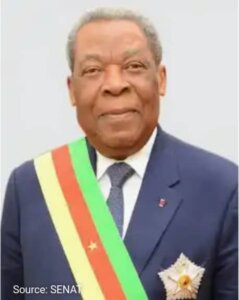
Born in 1934 in Bangangté in Nde Division of the West Region, Niat belonged to a generation of Cameroonians sent abroad to master the tools of the modern world. He graduated from the prestigious École Supérieure d’Électricité (Supélec) in Paris in 1960 – the very year of French Cameroon’s independence. Returning home as an engineer of roads and bridges, he was immediately thrust into the Herculean task of nation-building.
During his life time, Niat Njifenji was of the ruling Cameroon People’s Democratic Movement, the CPDM party serving in several high-profile ministerial roles. He was Minister of Planning and Territorial Administration and later as Deputy Prime Minister in charge of Mines, Water, and Energy.
The former Senate President was the technician the President called upon to solve complex logistical and resource challenges. His most critical role, however, came in May 2013 when he was elected Senate President.
As the first-ever President of the Senate, Niat occupied a position of immense constitutional weight. Under Article 7 of the recently amended Constitution, the President of the Senate was the designated successor to the Head of State in the event of a vacancy.
For 13 years, Niat was the “silent guarantor” of the State’s continuity. He managed the Senate not with flamboyant rhetoric, but with the steady, administrative hand of the engineer he always remained.
In 1974, Marcel Niat Njifenji was appointed Director-General of SONEL (the National Electricity Company). At the time, the country’s energy grid was fragmented and insufficient for industrial growth. Niat Njifenji approached the problem with the precision of a mathematician and the ambition of a visionary.