By Doh James Sonkey
The visiting Pope Leo XIV has told the President of the Republic, Paul Biya that “serving one’s country means dedicating oneself, with a clear mind and an upright conscience, to the common good of all people, the majority and the minorities, in their mutual harmony.”
His Holiness Pope Leo XIV was speaking at Unity Palace in Yaounde last April 15, 2026 on his day 1 of his four days visit to Cameroon.
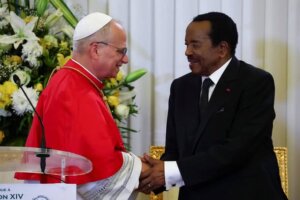
He said some 1600 years ago, Saint Augustine wrote words that remain remarkably relevant today: “Those who command are at the service of those whom they appear to command.
They do not command out of a thirst for domination, but out of a duty to provide for needs, not out of pride to impose themselves, but out of compassion to protect.”
The Head of the Roman Catholic Church in the world saluted Cameroon diversity not as weakness, but as treasure. It is a promise of fraternity and a solid foundation for building lasting peace
“I come among you as a pastor and servant of dialogue, fraternity, and peace.
My visit expresses the affection of the Successor of Peter for all Cameroonians, as well as the desire to encourage everyone to pursue, with enthusiasm and perseverance, the building of the common good.
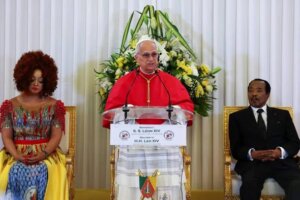
My great desire is to touch the heart of each person, especially that of young people, who are called to shape, including in the political sphere, a more just world.” Declared the President of the Holy See.
The Pope who was earlier received at the Yaoundé Nsimalen International Airport on behalf of the Head of State, H.E Paul Biya said he knows Cameroon is going through “complicated trials.
The tensions and violence that have struck certain regions of the Northwest, Southwest, and Far North have caused profound suffering: lives lost, families displaced, children deprived of schooling, young people who see no future.
Behind the statistics are faces, stories, shattered hopes. Faced with such dramatic situations, at the beginning of this year, I called on humanity to reject the logic of violence and war, to embrace a peace founded on love and justice.
A disarmed peace, that is, one not based on fear, threats, or weapons; and disarming, because it is capable of resolving conflicts, opening hearts, and fostering trust, empathy, and hope. Peace cannot be reduced to a slogan: it must be embodied in a personal and institutional style that rejects all forms of violence.
That is why I repeat it forcefully: “The world thirsts for peace.” Enough of wars, with their painful toll of death, destruction, and exile. This cry is intended as a call to action for a genuine peace, placing it above all partisan interests.”
He stressed that “peace, in fact, cannot be decreed; it must be welcomed and lived. It is a gift from God that develops through patient and collective work. It is everyone’s responsibility, first and foremost that of civil authorities. To govern is to love one’s country, but also neighboring countries.
The commandment “love your neighbor as yourself” also applies to international relations! To govern is to truly listen to citizens, to value their intelligence and their capacity to contribute to developing lasting solutions to problems.”